
A Anunciação – Monastério Ormylia
Vésperas da Anunciação
Anunciação:
E, no sexto mês, foi o anjo Gabriel enviado por Deus a uma cidade da Galileia, chamada Nazaré, a uma virgem desposada com um homem, cujo nome era José, da casa de Davi; e o nome da virgem era Maria.
E, vindo o anjo até ela, disse: Salve, agraciada; o Senhor é contigo; bendita és tu entre as mulheres.
E, vendo-o ela, turbou-se muito com sua palavra, e considerava que saudação seria esta.
Disse-lhe, então, o anjo: Maria, não temas, porque achaste graça diante de Deus.
E eis que em teu ventre conceberás e darás à luz um filho, e chamarás o seu nome Jesus.
Este será grande, e será chamado filho do Altíssimo; e o Senhor Deus lhe dará o trono de Davi, seu pai; e reinará eternamente na casa de Jacó, e o seu reino não terá fim.
E disse Maria ao anjo: Como se fará isto, visto que não conheço homem algum?
E, respondendo o anjo, disse-lhe: Descerá sobre ti o Espírito Santo, e o poder do Altíssimo te cobrirá com a sua sombra; por isso também o Santo, que de ti há de nascer, será chamado Filho de Deus.
E eis que também Isabel, tua prima, concebeu um filho em sua velhice; e é este o sexto mês para aquela que era chamada estéril;
Porque para Deus nada é impossível.
Disse então Maria: Eis aqui a serva do Senhor; cumpra-se em mim segundo a tua palavra.
E o anjo ausentou-se dela. (Lc 1, 26-38)
A festa da Libertação:
Novamente temos as boas novas da alegria, novamente os anúncios da liberdade, novamente a restauração, novamente o retorno, novamente a promessa de felicidade, novamente a libertação da escravidão.
Um anjo conversa com a Virgem, para que a serpente não tenha mais conversa com a mulher.
No sexto mês, diz-se, o anjo Gabriel foi enviado por Deus a uma virgem prometida em casamento a um homem.
Gabriel foi enviado para declarar a salvação mundial: Gabriel foi enviado para levar a Adão a assinatura de sua restauração; Gabriel foi enviado a uma virgem, a fim de transformar a desonra do sexo feminino em honra; Gabriel foi enviado para preparar o quarto digno para a esposa pura; Gabriel foi enviado para unir a criatura ao Criador; Gabriel foi enviado ao palácio animado do Rei dos anjos; Gabriel foi enviado a uma virgem prometida a José, mas preservada para Jesus, o Filho de Deus.
O servo incorpóreo foi enviado à virgem imaculada.
Um livre de pecado foi enviado àquela que não admitia corrupção. A luz foi enviada para anunciar o Sol da justiça.
A aurora foi enviada para preceder a luz do dia.
Gabriel foi enviado para proclamar Aquele que está no seio do Pai, e que ainda assim estaria nos braços da mãe.
Gabriel foi enviado para declarar Aquele que está no trono, e ainda assim na caverna.
O subalterno foi enviado para proferir em voz alta o mistério do grande Rei; o mistério, quero dizer, que é discernido pela fé, e que não pode ser buscado por curiosidade intrometida; o mistério que deve ser adorado, não pesado; o mistério que deve ser tomado como algo divino, e não medido.
“No sexto mês, Gabriel foi enviado a uma virgem.”
O que significa esse sexto mês? O quê? É o sexto mês desde que Isabel recebeu as boas novas, desde que concebeu João.
E como isso fica claro? O próprio arcanjo nos dá a interpretação, quando diz à virgem: “Eis que Isabel, tua parenta, também concebeu um filho na sua velhice; e este é agora o sexto mês para aquela que era chamada estéril.”
No sexto mês — ou seja, evidentemente, o sexto mês da concepção de João.
Pois era conveniente que o subordinado fosse adiante; era conveniente que o assistente precedesse; era conveniente que o arauto da vinda do Senhor preparasse o caminho para Ele.
No sexto mês, o anjo Gabriel foi enviado a uma virgem prometida em casamento a um homem; prometida, mas não unida; prometida, porém mantida unida.
E com que propósito ela estava prometida em casamento? Para que o destruidor não descobrisse o mistério prematuramente.
Pois que o Rei viria por meio de uma virgem era um fato conhecido pelo maligno.
Ele também ouvira as palavras de Isaías 4: “Eis que a virgem conceberá e dará à luz um filho”.
E, consequentemente, em todas as ocasiões, ele vigiava as palavras da virgem, para que, quando esse mistério se cumprisse, pudesse preparar a sua desonra.
Portanto, o Senhor veio por meio de uma virgem prometida em casamento, a fim de escapar da atenção do maligno; pois aquela que estava prometida em casamento estava, enfim, destinada a ser do seu marido.
“No sexto mês, o anjo Gabriel foi enviado a uma virgem prometida em casamento a um homem chamado José.”
Ouçam o que o profeta diz sobre este homem e a virgem: “Este livro selado será entregue a um homem instruído.”
O que significa este livro selado senão a virgem imaculada? De quem ele deve ser dado? Dos sacerdotes, evidentemente.
E a quem? Ao artesão José.
Visto que os sacerdotes desposaram Maria com José como a um marido prudente, e a confiaram aos seus cuidados na expectativa do casamento, e visto que lhe convinha, ao obtê-la, manter a virgem intocada, isso já havia sido anunciado pelo profeta muito antes, quando disse: “Este livro selado será entregue a um homem instruído.”
E esse homem dirá: “Não consigo lê-lo.”
Mas por que não consegues lê-lo, ó José? Não consigo lê-lo, diz ele, porque o livro está selado.
Para quem, então, ele é preservado? É preservado como um lugar de repouso para o Criador do universo. (Pseudo-Gregório Taumaturgo, Homilias sobre a Anunciação, 3)
Fonte 1: Texto traduzido de “Uma antiga Homilia sobre a Anunciação”
O Ícone:
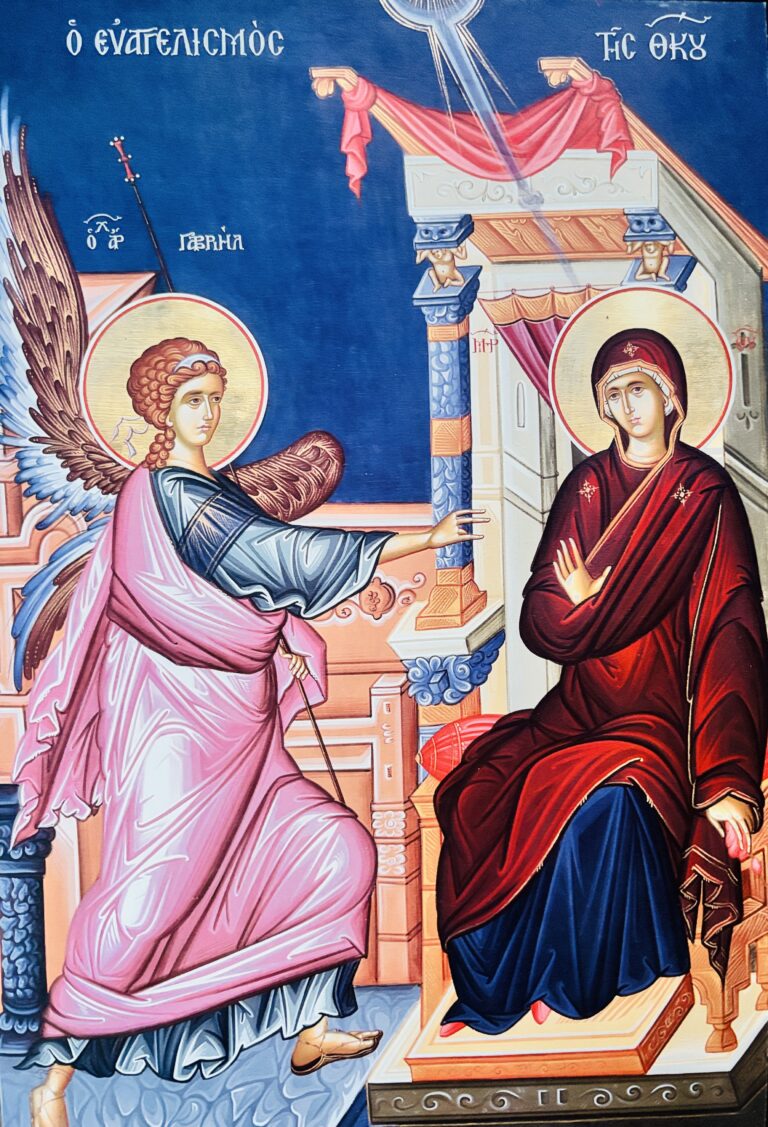
O ícone está repleto de cores vibrantes, para mostrar a alegria desta festa. Nele, vemos as figuras do Arcanjo Gabriel e de Maria.
Os pés de Gabriel estão afastados, como se ele estivesse quase correndo para saudar Maria com a notícia.
Em sua mão esquerda, Gabriel segura um cajado, símbolo de um mensageiro.
Ele estende a mão direita em direção a Maria ao anunciar a bênção que lhe será concedida.
Se observarmos Maria no ícone, podemos aprender muito com a forma como ela é representada.
Cantamos que ela é “mais honrada que os Querubins e incomparavelmente mais gloriosa que os Serafins”.
No ícone, ela está sentada em um assento elevado, representando seu papel sublime como Mãe de Deus.
Em sua mão esquerda, ela segura um fio.
A tarefa de Maria, enquanto esteve no templo, foi tecer o tecido púrpura e vermelho que seria usado para fazer o véu do templo.
No ícone, sua mão direita está erguida. Isso demonstra sua aceitação do que Gabriel lhe diz.
Maria poderia ter dito não, mas aceita por sua disposição em seguir a vontade de Deus.
Ela é um grande exemplo para todos nós nesse sentido.
Em suas vestes, você notará três estrelas douradas.
Você verá isso em muitos ícones da Mãe de Deus.
Essas três estrelas representam que Maria era virgem antes, durante e depois do nascimento de Cristo.
No topo do ícone há um círculo do qual parecem emanar raios de luz.
Isso representa o Espírito Santo descendo sobre ela nesta festa milagrosa.
Fonte 2: Texto traduzido de “Ícone da Anunciação”
Feast of libertation:
Again have we the glad tidings of joy, again the announcements of liberty, again the restoration, again the return, again the promise of gladness, again the release from slavery.
An angel talks with the Virgin, in order that the serpent may no more have converse with the woman.
In the sixth month, it is said, the angel Gabriel was sent from God to a virgin espoused to a man.
Gabriel was sent to declare the world-wide salvation: Gabriel was sent to bear to Adam the signature of his restoration; Gabriel was sent to a virgin, in order to transform the dishonour of the female sex into honour; Gabriel was sent to prepare the worthy chamber for the pure spouse; Gabriel was sent to wed the creature with the Creator; Gabriel was sent to the animate palace of the King of the angels; Gabriel was sent to a virgin espoused to Joseph, but preserved for Jesus the Son of God.
The incorporeal servant was sent to the virgin undefiled. One free from sin was sent to one that admitted no corruption.
The light was sent that should announce the Sun of righteousness.
The dawn was sent that should precede the light of the day.
Gabriel was sent to proclaim Him who is in the bosom of the Father, and who yet was to be in the arms of the mother.
Gabriel was sent to declare Him who is upon the throne, and yet also in the cavern.
The subaltern was sent to utter aloud the mystery of the great King; the mystery, I mean, which is discerned by faith, and which cannot be searched out by officious curiosity; the mystery which is to be adored, not weighed; the mystery which is to be taken as a thing divine, and not measured.
“In the sixth month Gabriel was sent to a virgin.” What is meant by this sixth month? What? It is the sixth month from the time when Elisabeth received the glad tidings, from the time that she conceived John.
And how is this made plain? The archangel himself gives us the interpretation, when he says to the virgin: “Behold, thy relation Elisabeth, she hath also conceived a son in her old age: and this is now the sixth month with her, who was called barren.”
In the sixth month-that is evidently, therefore, the sixth month of the conception of John.
For it was meet that the subaltern should go before; it was meet that the attendant should precede; it was meet that the herald of the Lord’s coming should prepare the way for Him.
In the sixth month the angel Gabriel was sent to a virgin espoused to a man; espoused, not united; espoused, yet kept intact.
And for what purpose was she espoused? In order that the spoiler might not learn the mystery prematurely.
For that the King was to come by a virgin, was a fact known to the wicked one.
For he too heard these words of Isaiah: 4, “Behold, a virgin shall conceive, and bear a son.”
And on every occasion, consequently, he kept watch upon the virgin’s words, in order that, whenever this mystery should be fulfilled, he might prepare her dishonour.
Wherefore the Lord came by an espoused virgin, in order to elude the notice of the wicked one; for one who was espoused was pledged in fine to be her husband’s.
“In the sixth month the angel Gabriel was sent to a virgin espoused to a man whose name was Joseph.”
Hear what the prophet says about this man and the virgin: “This book that is sealed shall be delivered to a man that is learned.”
What is meant by this sealed book, but just the virgin undefiled? From whom is this to be given? From the priests evidently. And to whom? To the artisan Joseph.
As, then, the priests espoused Mary to Joseph as to a prudent husband, and committed her to his care in expectation of the time of marriage, and as it behooved him then on obtaining her to keep the virgin untouched, this was announced by the prophet long before, when he said: “This book that is sealed shall be delivered to a man that is learned.” And that man will say, “I cannot read it.”
But why canst thou not read it, O Joseph? I cannot read it, he says, because the book is sealed.
For whom, then, is it preserved? It is preserved as a place of sojourn for the Maker of the universe.
Icon o Annuciation:
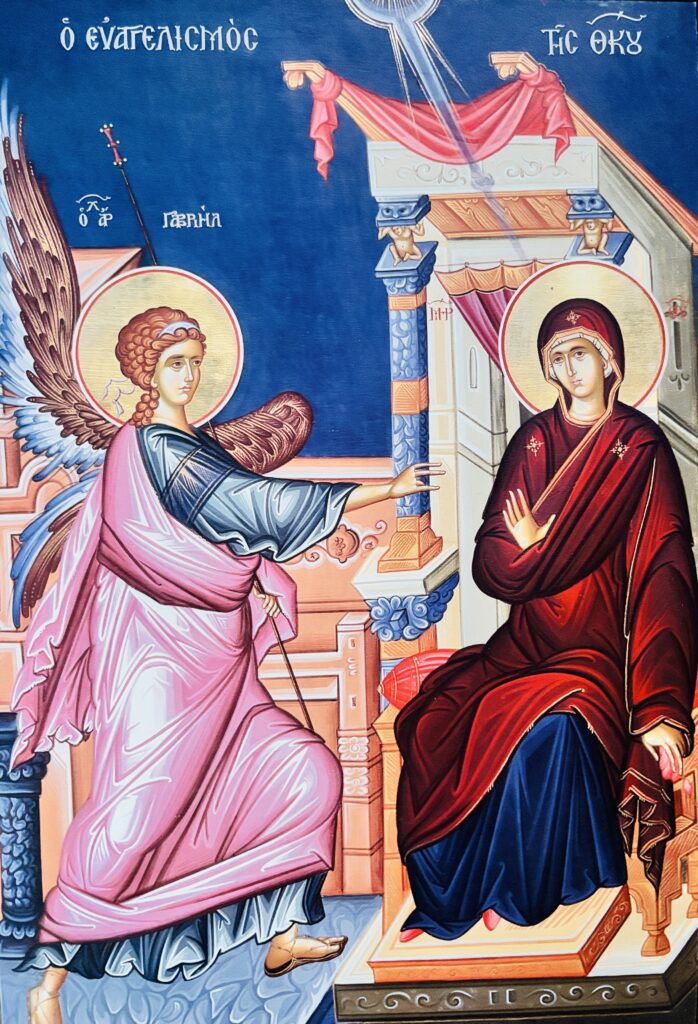
If we look at Mary in the icon, there are many things we can learn from how she is depicted as well.
We sing that she is “more honorable than the Cherubim and beyond compare more glorious than the Seraphim.”
In the icon, she is seated in an elevated seat, representing her elevated role as the Mother of God.
In her left hand she is holding thread.
Mary’s task while she stayed in the temple was to weave the purple and red material to be used to make the veil of the Temple.
In the icon, her right hand is raised.
This is to show her acceptance to what Gabriel is telling her.
Mary could have said no, but she accepts out of her willingness to follow the will of God.
She is a great example for all of us in this regard.
On her garments, you will notice three gold stars. You will see this in many icons of the Mother of God.
These three stars represent that Mary was a virgin before, during and after the birth of Christ.
At the top of the icon is a circle with what appears to be rays of light coming from it.
This represents the Holy Spirit descending upon her at this miraculous feast.
Link dos artigos:
Link da fonte 1: https://www.orthodoxroad.com/a-timely-homily/
Link da fonte 2:
https://www.acrod.org/orthodox-christianity/youthreadingroom/iconography/annunciationicon
Divulgado por